


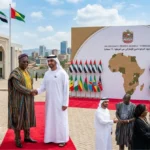




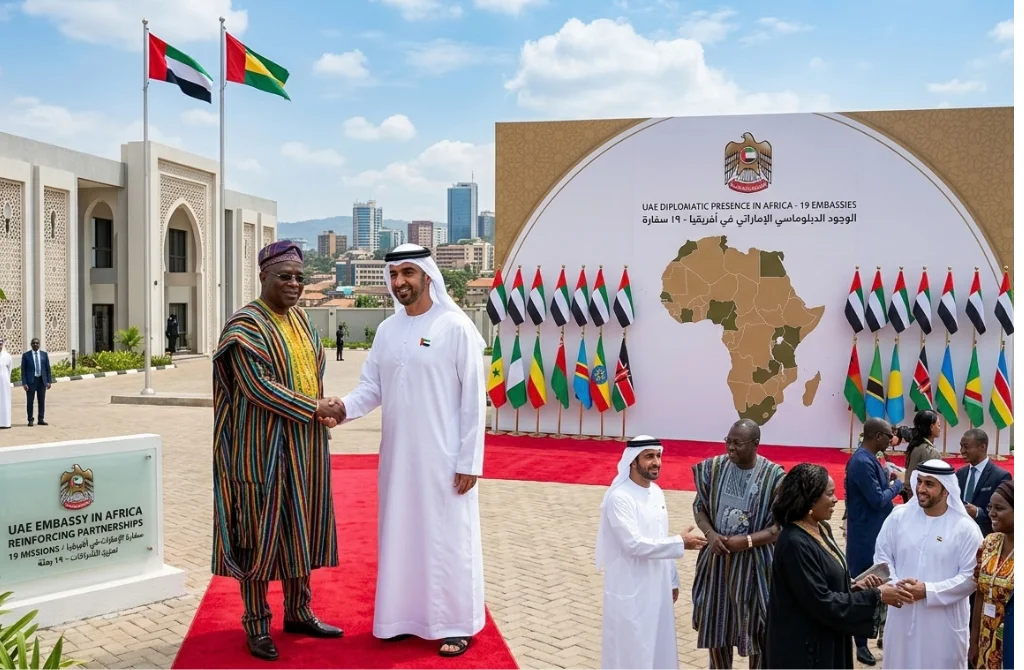
When discussing the influence of Gulf countries in Africa, one first thinks of massive investments and port concessions. Yet what underpins that influence is a more fundamental but often overlooked architecture: diplomatic presence. The United Arab Emirates now has 19 embassies in sub-Saharan Africa, and new representations continue to open.
The relationship between the UAE and Africa is not new. As Minister of State Sheikh Shakhboot bin Nahyan Al Nahyan recalled, ties between the two sides are rooted in centuries of commercial and human exchange across the Red Sea and the Indian Ocean.
These historical links are now reflected in a systematic diplomatic deployment: between 2010 and 2019, the UAE opened no fewer than eleven embassies in sub-Saharan Africa, and this network continues to expand. In January 2026, a federal decree formally approved the opening of an embassy in Windhoek, Namibia.
The UAE’s diplomatic deepening is not one-way. As the Emirati presence broadens in Africa, African countries’ representation in Abu Dhabi grows in parallel.
This mutual institutionalization is gradually making the UAE a hub for trade, finance and dialogue for the continent.
More strategically still, the UAE has obtained observer status at the African Union and participated in the AU summit in Addis Ababa in February 2026, reaffirming its support for Agenda 2063.
In April 2026, the Emirati ambassador to Nigeria formally presented his credentials to the Economic Community of West African States (ECOWAS) as permanent representative, thereby extending its diplomatic network to regional institutions.
The expansion of this diplomatic network provides an institutional framework for deeper cooperation.
Between 2019 and 2023, the UAE committed more than $110 billion in investments in Africa, the highest level of any country over the period. More than $70 billion went to energy and green sectors.
On trade, the UAE has signed Comprehensive Economic Partnership Agreements (CEPA) with nine African countries, including Nigeria, Kenya, the DRC and Angola, covering tariffs, services, digital trade and investment protection, in complementarity with the African Continental Free Trade Area (AfCFTA).
The UAE’s diplomatic presence in Africa deserves attention because it offers a model of cooperation distinct from that of traditional powers.
As analysts emphasize, Gulf countries “do not carry the historical burden of former colonial powers,” a relationship more easily accepted by African leaders keen to assert their sovereignty.
Nineteen embassies are not merely a number: they are the institutionalized expression of a long-term commitment. That means visa facilitation, consular services, business matchmaking and daily political dialogue.
For African countries, it represents a partner with permanent representation in Abu Dhabi, participating in the work of the African Union in Addis Ababa and dialoguing with ECOWAS in Abuja.
The deepening of this diplomatic presence lays the foundations for more durable and more resilient cooperation between the UAE and Africa.