


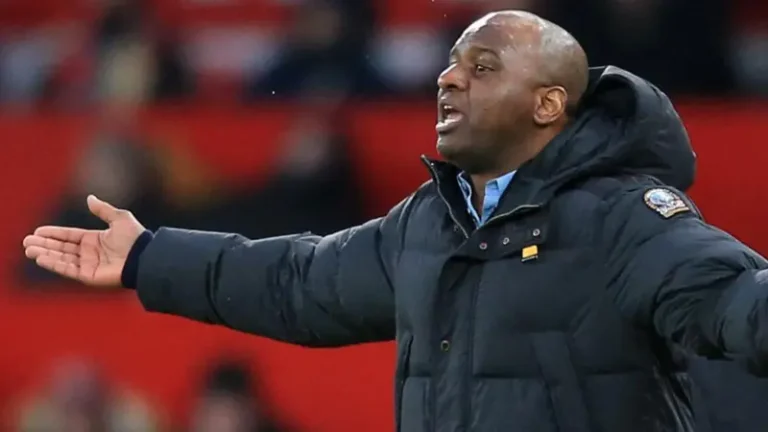
Patrick Vieira’s appointment as Senegal’s new coach comes at a particularly difficult time for the national team so much so that the former captain of the French national team may not even take the reins of the Lions of Teranga. The appointment of this 50-year-old man was announced even though he has not yet signed a contract, and the date of his official introduction remains unknown.
The Senegalese Football Federation (FSF), currently torn by off-field issues, stated that discussions regarding Vieira’s “administrative and contractual arrangements” are ongoing between the two parties. The former Arsenal and Inter Milan midfielder was unanimously approved to succeed Pape Thiaw at an FSF meeting on Monday, with former Dutch international Patrick Kluivert among the other names considered. However, uncertainty remains regarding the termination of Thiaw’s contract.
Vieira’s predecessor was fired following the dramatic elimination against Belgium in the round of 16 of the FIFA World Cup, without the Senegalese government which funds the national team having officially approved the decision. He is demanding payment of several months of unpaid wages as well as various bonuses, for a total amounting to nearly $815,000 (£600,000, nearly 450,000,000 CFA francs).
In addition, a decision regarding the election of the FSF’s current leadership which has been contested for the past year is expected by Friday from the Court of Arbitration for Sport (CAS).
With the FSF leadership increasingly isolated lacking support from both the government and the general public and under pressure from the CAS’s impending decision, it nevertheless had little choice but to act quickly to fill the vacant position with the Lions of Teranga. The schedule is packed: Senegal returns to competition on September 23 with an away game in Mozambique for its first Group J match in the 2027 Africa Cup of Nations (CAN) qualifiers. A match against Ethiopia will follow a few days later.
The CAS ruling in Lausanne could call into question the legitimacy of the FSF leadership and potentially even the selection of Vieira as head coach.
Furthermore, despite all his achievements as one of the greatest soccer players of the modern era, Vieira’s record as a coach has been less impressive.
A Long-Awaited Return Home
Beyond all that, Vieira’s connection to Senegal holds deep symbolic significance. Born in Dakar in June 1976 to a Cape Verdean mother and a Gabonese father, Vieira began kicking a soccer ball around on the sandy streets of the capital until he was eight years old.
His family moved to France, and his life took a different turn: he became a Premier League icon during his time with Arsenal, earning more than 100 caps for the French national team and helping Les Bleus win the World Cup in 1998 and the European Championship in 2000.
He faced Senegal only once as a player, in the opening match of the 2002 World Cup, when France suffered a surprise 1-0 loss to a team led by Aliou Cissé and featuring Thiaw the two men whose coaching legacies he is now carrying on. But Vieira never truly severed ties with his native country.
In fact, one of his most significant contributions came toward the end of his playing career, when he made a major investment in the creation of the Diambars Institute. It would go on to become one of Africa’s leading soccer academies and, less than twenty years later, one of the cornerstones of Senegal’s recent success.
Diambars has developed players such as Idrissa Gana Gueye, Bamba Dieng, and Abdoulaye Seck, all of whom have played a role in Senegal’s history since 2018.
Crowned African champions for the first time in February 2022 during the postponed 2021 Africa Cup of Nations, the Lions of Teranga clinched a second title with a 1-0 victory in extra time in the Africa Cup of Nations final in January. However, the fate of the trophy will be decided by the CAS after Thiaw sent his team off the field following a controversial penalty awarded to the host country, Morocco, in stoppage time.
The challenge facing Vieira is rebuilding a team that is trying to look toward the future after one of the most glorious chapters in its history. Many promising young talents are coming up, but these players will have to shoulder the weight of the formidable legacy left by the old guard Sadio Mané, Edouard Mendy, Kalidou Koulibaly, and Gana Gueye.
The list of candidates for the position of new coach included Kluivert, Vieira’s compatriot Patrice Carteron, and two former Senegalese internationals, Habib Beye and Oumar Daf.
The Frenchman dropped several hints suggesting he was a candidate for the job, particularly during the unusually extensive media coverage of his recent vacation in Senegal.